Essential goods in Malé cost 10% more than a year ago: what it means for your shop
· ISLEPOS
The Bureau of Statistics' October figures, out on 9 November, put essential goods in Malé 9.96% above October 2025, with meat, vegetables, coffee and cooking gas up the most. What rose, why the headline inflation figure looks so much lower, and what a shop should do about its prices.
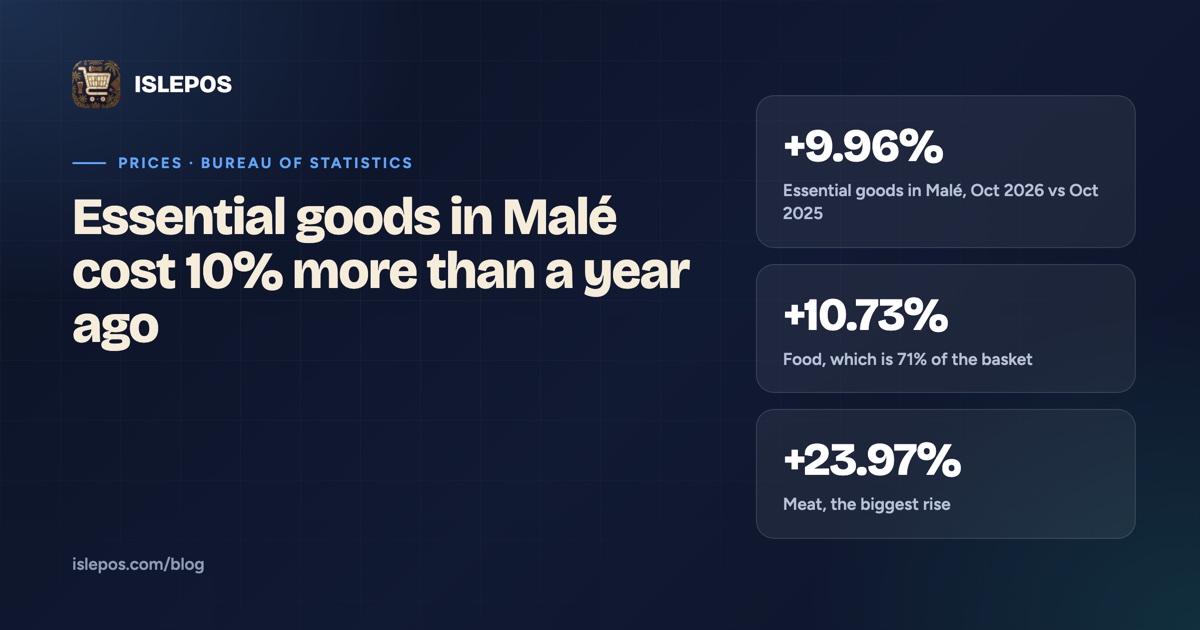
On 9 November the Maldives Bureau of Statistics published its Essential Commodities Price Index (ECPI) for October. It tracks what the basics cost in Malé: 96 everyday products — food, drinks, cooking gas and personal care items — priced 2,549 times a month in the capital's shops. In October that basket cost 9.96% more than a year earlier, and 1.01% more than in September alone (ECPI October 2026, Maldives Bureau of Statistics).
For a shop, that is two problems at once: what you pay to restock has gone up, and your customers notice every rufiyaa on the shelf. This post sets out what rose, why the country's headline inflation looks far lower, and what to do about your own prices.
1. What rose, and by how much
These are official statistics, not forecasts. Against October 2025, the Bureau's release and tables show (release PDF):
- Food: +10.73%. Food is 70.94% of the basket, so it drives the total.
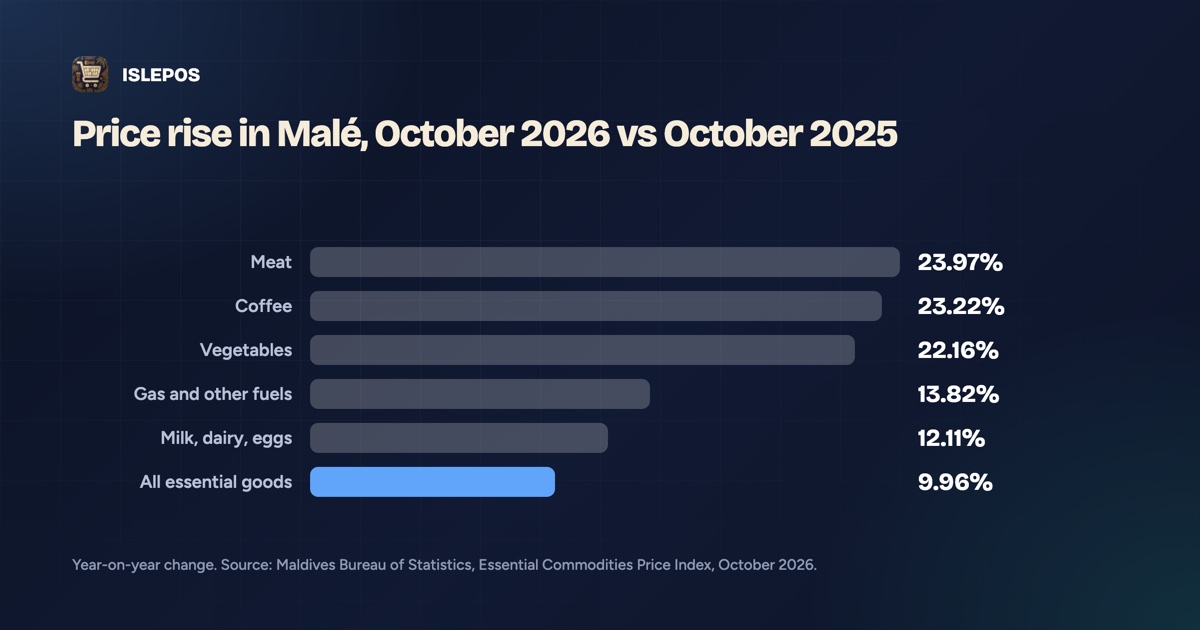
- Meat: +23.97%, the biggest rise of any food group. Vegetables: +22.16%. Fruit: +13.24%.
- Milk, other dairy products and eggs: +12.11%. Sugar, jam, honey, chocolate and confectionery: +10.63%. Oils and fats: +10.20%.
- Cereals: +4.77% and fish: +2.28% — the staples rose least.
- Coffee: +23.22%, pulling beverages up 7.42% overall.
- Gas and other fuels: +13.82%, and personal care products: +4.86%.
The speed is the story. In the Bureau's tables, the yearly rise was 1.05% in February. It reached 4.40% in April, 8.04% in June, 6.26% in August (Corporate Maldives), 7.79% in September and 9.96% in October. Some of the jumps came in single months: cooking gas and fuel rose 12.48% in March, and meat 14.58% in April. Vegetables swing hardest of all — up 20.86% in June, down 10.89% in July.
2. Why the headline figure says only about 1%
If you have read that inflation is low, you have not misread it. The Bureau's national Consumer Price Index for September, published on 26 October, rose just 1.17% in a year (CPI September 2026). The same release shows food and beverages including fish up 8.59%, and transport up 7.75%. What pulls the total down is mostly one group: tobacco and areca nuts, down 29.11%. Rent, electricity, phone and education barely moved.
So the headline figure is right, but it is an average of a household's whole budget. The ECPI covers what a grocery, minimart or café actually sells. If that is your shop, the 10% figure is the one that describes your shelves. (The October CPI is not out yet; the ECPI covers Malé only, and the CPI also reports the atolls separately.)
3. Why prices are rising
The Bureau reports what changed, not why. Two things on the record fit the timing. On 5 March, the State Trading Organization raised petrol from MVR 13.50 to MVR 16.01 a litre and diesel from MVR 13.92 to MVR 17.54, up to 26%, after global oil prices jumped (Corporate Maldives) — the same month the index's gas and fuel group rose 12.48%. Dearer fuel feeds into freight, boats and cold storage, and so into food. And the Maldives is paying more for what it brings in: imports rose 27.8% to about USD 3.35 billion in January to September, with petroleum more than half of the increase, according to the Maldives Monetary Authority's figures as reported by Maaldif.
The Bureau notes that the ECPI is used "to impose price regulations" and as an early warning of inflation in essentials. We found no new price controls announced this week. But a 10% rise in the very index the government uses for that purpose is worth watching, especially if you sell staples.
4. What it means for a shop
- Old prices on new stock lose money. If you priced a carton of milk or a tin of coffee in spring and have not changed it, your margin on that line may have shrunk by the whole rise — around 12% for dairy, more for coffee.
- Your stock is worth more to replace than you paid. Selling it at last year's markup means the next order costs more than the takings it earned.
- Customers are counting. When meat and vegetables rise by a fifth, shoppers compare. Small, steady changes, backed by your own costs, go down better than one big jump.
- Perishables are the risk. Vegetable and fruit prices move by 10–20% in a month. Buy for the week, not the month, unless you have the cold storage and the buyers.
What to do this week
- List your 20 fastest sellers in the groups that rose most: meat, dairy and eggs, oils, sugar, coffee, vegetables.
- Compare each one's last purchase cost with its shelf price. Use the newest invoice, including freight to your island, not the average of the year.
- Reprice when new stock arrives, not when the old stock runs out — and check every delivery, not once a quarter.
- Watch staples carefully. Keep proof of your costs for anything that could come under price regulation, and do not raise a price you cannot explain.
- Check again on 9 December, when the Bureau publishes the November ECPI, and look for the October CPI before then.
In ISLEPOS, receiving stock records what each delivery cost you, landed costs add the freight and duty, stock value shows what your shelves are worth at those costs, and you can update prices as soon as the new cost is in.
Sources
- ECPI October 2026 — Maldives Bureau of Statistics, 9 November 2026
- Essential Commodities Price Index, Monthly Release October 2026 — Malé (PDF) — Maldives Bureau of Statistics, 9 November 2026
- ECPI October 2026 — Malé, tables — Maldives Bureau of Statistics, 9 November 2026
- Consumer Price Index, September 2026 — Maldives Bureau of Statistics, 26 October 2026
- Diesel and petrol prices rise sharply after global oil disruptions — Corporate Maldives, 5 March 2026
- Malé essential goods prices rise 6.26% over year — Corporate Maldives, 10 September 2026
- MMA: construction strength and tourism resilience support Maldives economy as 2026 growth outlook reaches 0.6% — Maaldif, 6 November 2026