GST in 2027: what changes for small shops in the Maldives
· ISLEPOS
From 1 January every GST return goes through MIRAconnect, the registration threshold is set to rise to MVR 1.5 million, and e-invoicing is on the way. What is law, what is still a promise, and what to do before the year ends.
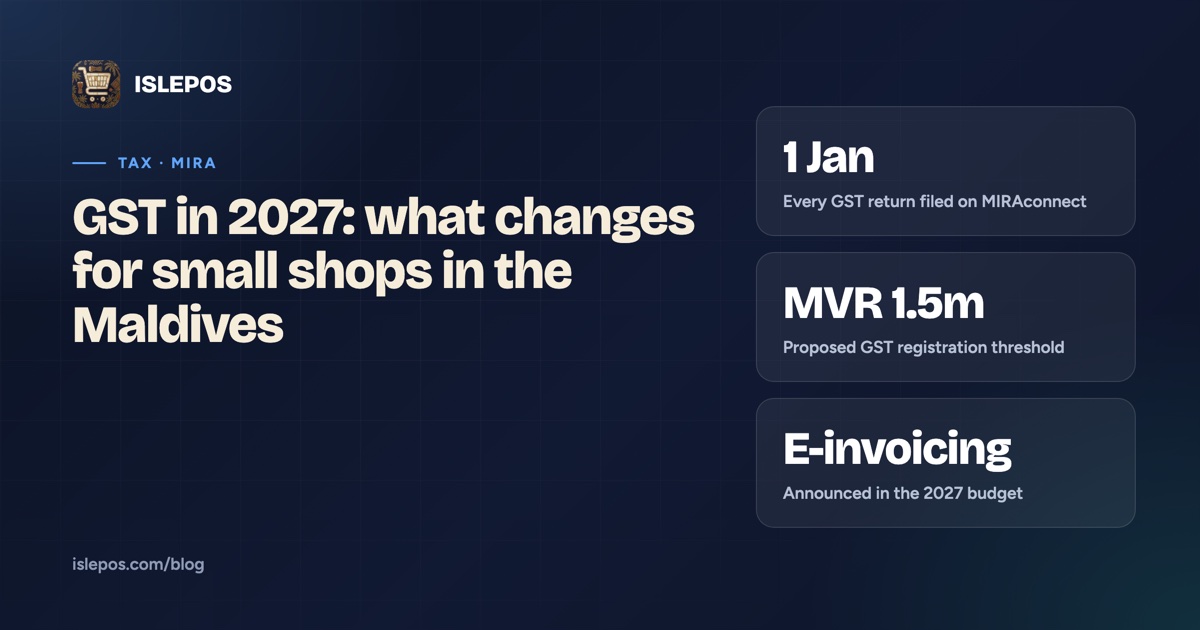
Three weeks of announcements have changed what running a small shop in the Maldives will look like next year. A regulation already in the Gazette moves every GST return online from 1 January. The President has promised a higher GST registration threshold and duty-free raw materials for small businesses. And the 2027 budget, presented to Parliament on 29 October, promises no new tax rises but much closer watching of the taxes that already exist — including a new e-invoicing system.
Some of this is law and some of it is not yet. This post separates the two, and ends with what is worth doing before 31 December.
1. GST returns move to MIRAconnect on 1 January — this one is law
On 21 September 2026 MIRA published the 32nd amendment to the GST Regulation, Regulation 2026/R-82, in the Government Gazette. It says that everyone who is registered for GST, or should be, must file their GST return through MIRAconnect from 1 January 2027, and pay GST and any GST fines through MIRAconnect or MRTGS. The older filing channels can be used only until 31 December 2026 (LookupTax summary of the regulation).
Until now, online filing was compulsory only for businesses above a turnover limit. From January it applies to every GST-registered business, however small. The Commissioner General can allow another channel where there is a reasonable excuse, but nobody should plan around that.
2. The GST registration threshold is set to rise to MVR 1.5 million — announced, not yet law
Speaking at the Maldives Expo 2026 awards on the night of 24 October, President Dr Mohamed Muizzu said the MVR 1 million threshold would rise to MVR 1.5 million from 1 January 2027. "Our hope is to increase the threshold to MVR 1.5 million from 1st January," he said, adding that the law and regulations still have to be amended (Edition.mv). The Maldives Independent's summary of the budget lists it as the GST registration threshold, measured on annual turnover.
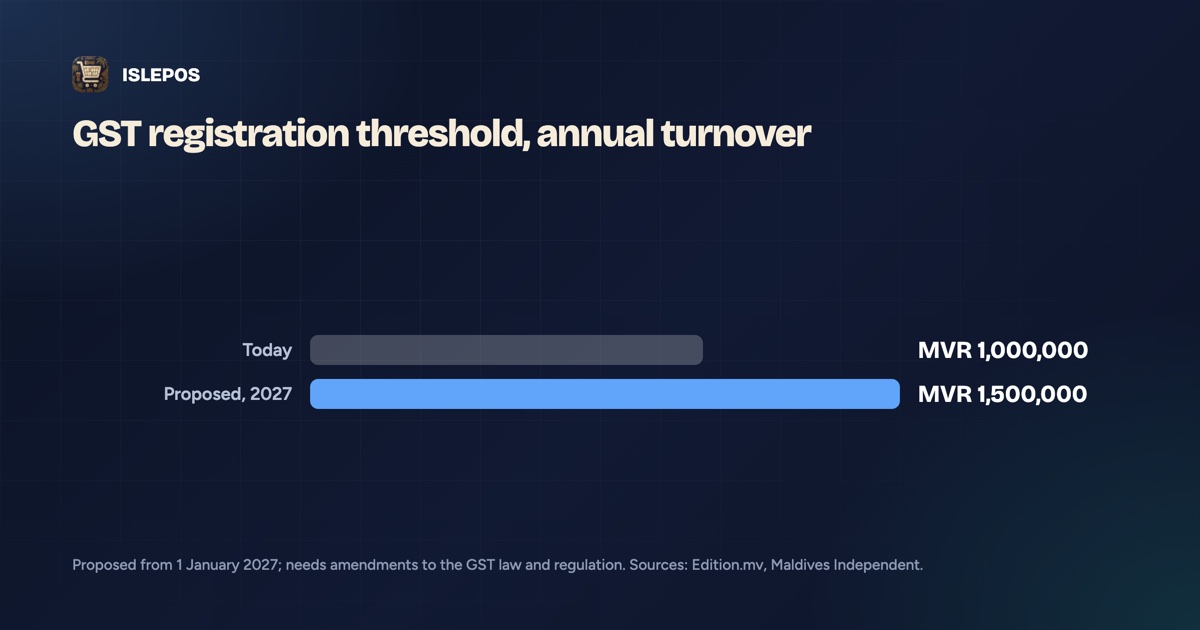
If your shop sells between MVR 1 million and 1.5 million a year, this could take you out of GST altogether. But as of today there is no MIRA notice or gazetted amendment, and there is no detail yet on whether businesses already registered in that band will be able to deregister, or how. Until there is, keep charging, recording and filing as you do now.
3. No tax rises — but much closer checking
Presenting the budget, Finance Minister Hassan Zareer said the government "will not increase any existing taxes in the coming year" (Edition.mv). Of the MVR 43.1 billion in revenue and grants the budget expects, MVR 33.6 billion is to come from taxes.
That money is to come from collecting what is already owed: closing loopholes, enforcing tax laws more strictly, wider use of the Maldives Guest Information System, and moving the Customs Service's revenue role under the Finance Ministry. And, in the minister's words, "a modern e-invoicing system will be introduced" to strengthen the tax system.
No date or technical detail has been published for e-invoicing. In countries that have introduced it, invoices are issued in a fixed electronic format and reported to the tax authority as they are made, so the authority sees sales as they happen rather than once a quarter. Whatever shape the Maldivian version takes, the businesses that will find it easiest are those whose every sale already produces a numbered invoice or receipt in a system — not a handwritten book.
4. Duty-free raw materials and a tax offset for SMEs
The President also announced that raw materials on a government list, imported by small businesses for production, will be free of import duty for five years from 1 January 2027, and that money the government owes an SME will be set against the tax the SME owes — if the government owes more, the business pays nothing and can claim the difference (Edition.mv). The list of raw materials has not been published, and no start date has been given for the offset.
If you make or process goods — bakeries, furniture, garments, food products — watch for the list from the Ministry of Economic Development and Customs, and start keeping your import documents for raw materials separately from those for goods you resell.
5. US dollar payments for small exporters
From 1 November, Maldivian manufacturers and SMEs selling to overseas customers can apply for access to BML's US dollar payment gateway. Businesses request it through the Business Center Corporation (BCC) portal; once BCC refers them, BML collects the documents and links the account to the gateway. The dollars received can be spent on subscriptions and other international payments with a linked USD debit card (Edition.mv).
What to do before 31 December
- Test your MIRAconnect login now, and give access to whoever prepares your return. From 1 January there is no paper or counter fallback.
- Work out your turnover for 2026. If it sits between MVR 1 million and 1.5 million, you are the business the threshold change is about — but keep filing until MIRA says otherwise.
- Get every sale into a system. No-tax-rise budgets that rely on enforcement and e-invoicing reward shops whose sales, invoices and GST add up without being rebuilt at the end of the quarter.
- Keep raw-material imports apart from goods for resale, so you can claim the duty exemption when the list is out.
- Exporters: apply through the BCC portal for BML's USD gateway if you sell abroad.
ISLEPOS keeps the figures a GST return needs as you sell: the output tax on each sale and invoice, the input tax on what you buy, and a quarter report with what is left to pay. You can prepare and record each quarter's filing and then submit it on MIRAconnect. We will write again when the threshold amendment and the e-invoicing rules are published.
Sources
- Gazette Vol. 55 No. 150 — GST Regulation, 32nd amendment (2026/R-82) — Government Gazette of the Maldives, 21 September 2026
- Maldives makes MIRAconnect the mandatory channel for GST filing and payment — LookupTax, 21 September 2026
- Concessions for SMEs, taxes and subscriptions — Edition.mv, 25 October 2026
- No tax hikes next year: Finance Minister — Edition.mv, 29 October 2026
- After the sukuk: the 2027 budget in numbers — Maldives Independent, 2 November 2026
- BML to open USD Payment Gateway access for SMEs — Edition.mv, 1 November 2026