Buying stock from China? How the free trade agreement cuts your import duty
· ISLEPOS
A guide for shops that import from China: which goods are already duty-free under the China–Maldives Free Trade Agreement, which get cheaper again on 1 January 2027, and the certificate of origin you need to claim it.
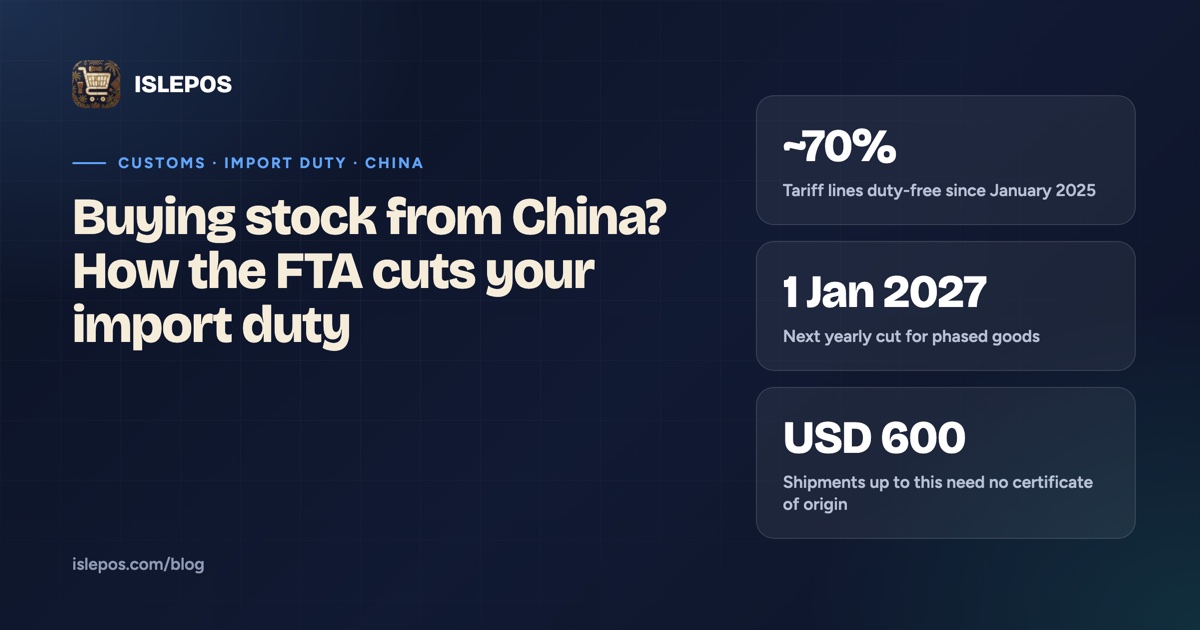
This week brought no new tax or customs rule that changes how a shop runs, so this post is a guide rather than news. It answers a question that matters more every month: if you buy stock from China, are you paying less import duty than you should?
Speaking at the China–Maldives Investment Cooperation Forum in Malé on 28 October, President Dr Mohamed Muizzu said goods worth about USD 440 million were imported from China between January 2025 and August 2026, and that about USD 124 million of that — more than a quarter — came in under the Free Trade Agreement (President's Office). Put the other way round, most goods from China still came in without the agreement being used. Some will not qualify; many simply lacked the paperwork.
1. The agreement is law, and has been since January 2025
The China–Maldives Free Trade Agreement was signed in Beijing on 7 December 2017 (agreement text, Ministry of Economic Development and Trade) and came into force on 1 January 2025, as the trade ministry announced in the Government Gazette that day. Maldives Customs put the agreement's duty rates on its tariff search, and traders claim them by submitting a certificate of origin with the goods declaration (Maritime Updates, Maldives).
Usage started small. In February 2025, Economic Minister Mohamed Saeed said FTA relief claimed in the first weeks came to MVR 2.3 million, about 1% of imports (AO News). By the President's figure, it has grown to about a quarter of goods from China — so importers are learning to use it.
2. Which goods: four categories in the tariff schedule
Every item the Maldives imports is listed, with its HS code, in the Maldives tariff schedule annexed to the agreement. Each line has a base rate (the normal duty in force on 1 January 2014) and one of four staging categories. By our count of the schedule's roughly 8,600 lines:
- Category A — about 70% of lines: duty-free since the first day, 1 January 2025. Examples include electric lamps and chandeliers (base rate 20%), mobile phones (5%) and many items already at 0%.
- Category B — about 20%: duty removed in five equal yearly steps, reaching zero on 1 January 2029. A sewing kit, correction tape or straw basket with a 25% base rate is at 15% this year and drops to 10% on 1 January 2027.
- Category C — about 5%: removed in eight equal yearly steps, reaching zero on 1 January 2032. Window and wall air conditioners and USB cables (20% base) are in this group: 15% in 2026, 12.5% in 2027.
- Category E — about 4%: no cut at all. Plastic bags (400%) and cigars (200%) are here.
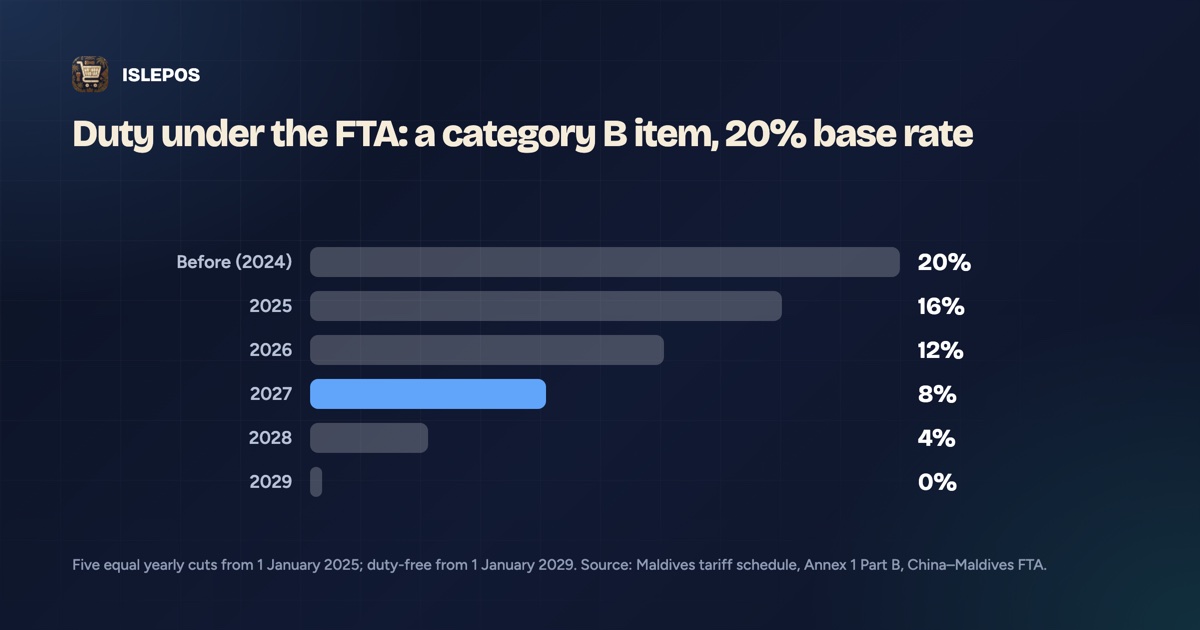
One caution. The schedule's base rates are the 2014 rates, and the Maldives has changed many normal rates since. The FTA rate is worth claiming only when it is lower than the rate you would otherwise pay. Look up your item's HS code on the Maldives Customs tariff search, which is where the rate that applies today is shown.
3. What you need to claim it
Duty-free treatment is not automatic. Under the agreement's rules of origin (agreement text, Chapter 4), these are the parts that catch shops out:
- The goods must be made in China. Goods count if wholly made there, or if at least 40% of their value was added there, unless the product rules in Annex 2 say otherwise (Article 17). Repacking or relabelling alone does not make a product Chinese (Article 21).
- A certificate of origin. Your supplier applies for it from an authorised body in China, in English, before or at shipment. It is valid for one year (Article 28). You must hold it when the goods declaration is lodged and say on the declaration that the goods qualify (Article 30). Customs publishes the certificate form so you can show your supplier what is needed.
- No certificate needed up to USD 600. Consignments with a customs value of USD 600 or less are exempt — but not if a bigger order is split up to stay under the limit (Article 32).
- Shipped direct. Goods may pass through another port, such as Colombo, for up to three months, but must stay under customs control there and not be traded (Article 27). Stock bought from a trader in Dubai or Singapore, even if made in China, will usually not qualify.
- Forgot the certificate? You can declare the goods as originating, pay the normal duty or a guarantee, and apply for a refund within the period Maldivian law allows (Article 31). Ask Customs or your clearing agent how long that is before you rely on it.
4. What it means for your prices
On an order of lamps worth MVR 50,000 at the border, a 20% duty is MVR 10,000. Under the FTA that is zero — if the paperwork is right. On a category B item the saving grows every January, so a landed cost you worked out in 2025 is already out of date. Recalculate when each new rate starts, and decide whether to pass the saving on or keep it as margin. For goods from China that sell on price — household goods, electrical items, stationery — a competitor who claims the FTA and you who don't are not buying at the same cost.
What to do this month
- List what you buy from China and find each item's HS code on your last customs declaration.
- Look up each code in the tariff search and the FTA schedule to see its category and today's rate.
- Ask every Chinese supplier whether they can issue the FTA certificate of origin, and put it in your next order.
- Ship direct where you can, and keep the bill of lading and any transit papers.
- On 1 January 2027, recheck landed costs for category B and C items.
In ISLEPOS, you can add each supplier, raise purchase orders in the supplier's currency at a saved exchange rate, keep the certificate with the shipment's documents, and add duty and freight as landed costs, so each item's cost shows what you really paid.
Sources
- Maldives is open to responsible investment, and committed to making that investment succeed: President — The President's Office, 28 October 2026
- Free Trade Agreement between the Government of the Republic of Maldives and the Government of the People's Republic of China — Ministry of Economic Development and Trade, 7 December 2017
- Annex 1, Part B: Tariff Schedule of Maldives — Ministry of Economic Development and Trade, 7 December 2017
- China–Maldives Free Trade Agreement: notice of entry into force — Government Gazette, 1 January 2025
- Certificate of Origin: Form for China–Maldives Free Trade Agreement — Maldives Customs Service, 31 October 2024
- Customs announces duty rates under China–Maldives FTA — Maritime Updates, Maldives, 5 January 2025
- Gov't denies revenue hit from Free Trade Agreement — AO News, 17 February 2025