The GST threshold is now law at MVR 1.5 million: what it means for your shop
· ISLEPOS
The ninth amendment to the GST Act was published in the Gazette on 19 November. From 1 January a business registers for GST above MVR 1.5 million a year, a registered one can leave only below MVR 750,000, and MIRA says every GST return goes online. Who it helps, who it does not, and what to do before January.
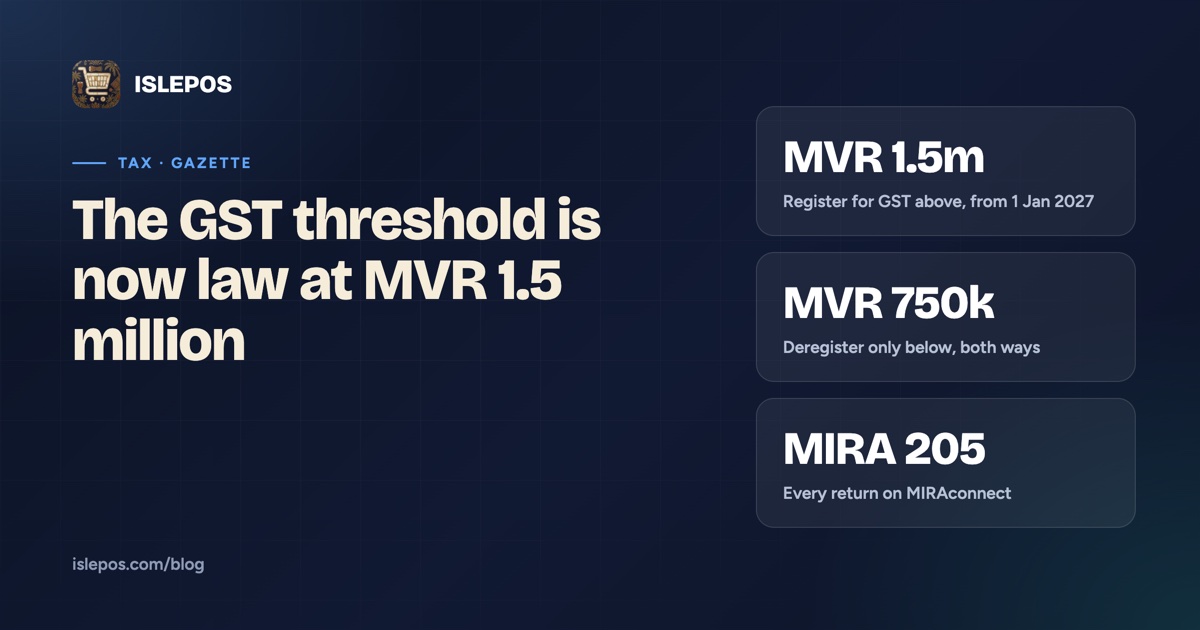
Three weeks ago we wrote that the GST registration threshold was set to rise to MVR 1.5 million, and that it was only a promise until the law changed (GST in 2027). It has now changed. Parliament passed the amendment on 17 November with 66 votes for and none against (Atoll Times), and on 19 November it was published in the Government Gazette as Law 19/2026, the ninth amendment to the Goods and Services Tax Act (Gazette).
So this is law, not an announcement. But the details matter more than the headline, because the rule for leaving GST is not the same as the rule for joining it. Here is what changed, who it helps, and what a shop should do before 1 January.
1. Registering: MVR 1.5 million from 1 January
Under the amended section 51, a business in the Maldives must register for GST when the goods and services it supplies here, over any 12 months or a shorter period, come to more than MVR 1,500,000. The old MVR 1 million rule stays in force until 31 December 2026; the new one applies from 1 January 2027 (Law 19/2026, Gazette). Finance Minister Hassan Zareer had said the change was meant to support small and medium businesses (Atoll Times).
Turnover is not the only trigger. KPMG's summary of the new laws notes that tourism suppliers and importers still have to register whatever their turnover (KPMG, 23 November). If you bring in your own stock through customs, the higher threshold may not take you out of GST at all.
2. Leaving: only below MVR 750,000
This is the part most shops will miss. The new law lets a registered business apply to MIRA to deregister from 1 January 2027, but only if all three of these are true (Law 19/2026, Gazette):
- at the end of any month, what it supplied in the past 12 months was less than MVR 750,000;
- what it expects to supply in the next 12 months is also less than MVR 750,000; and
- it does not meet any of the other conditions in section 51 that make registration compulsory.
KPMG reads this as the deregistration level rising from MVR 500,000 to MVR 750,000 (KPMG). Nothing in the law takes a business off the register by itself: you have to apply.
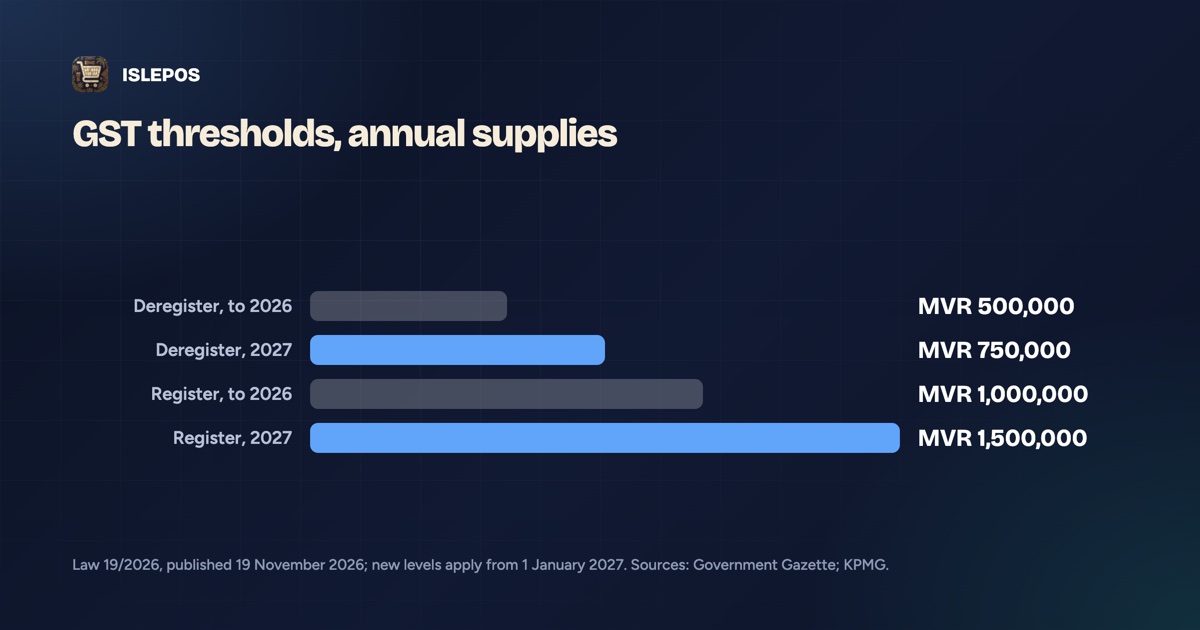
Put the two rules side by side and the effect is plain. A shop that is already registered and sells MVR 1.2 million a year does not get to leave GST in January. It is below the new registration line but well above the MVR 750,000 exit line, so it keeps charging GST and filing returns. The higher threshold mostly helps businesses that are not yet registered: a shop that grows past MVR 1 million in 2027 does not have to register until it passes MVR 1.5 million.
3. Every GST return online from January
Separately, MIRA issued a circular dated 23 November reminding businesses that from 1 January 2027 every general-sector GST taxpayer must file the GST return (MIRA 205) through MIRAconnect, and pay through MIRAconnect or MRTGS, whatever its turnover. Until now, online filing was compulsory only from MVR 2.5 million a year and electronic payment from MVR 20 million (Maldives Business Review, 24 November). The rule itself is in a regulation gazetted in September, as we covered in our earlier post; the circular is MIRA telling businesses it starts in five weeks.
If you have been filing on paper or at the counter, check now that you can log in. MIRA says it sends MIRAconnect login details to a taxpayer's registered email address, and has a user guide for filing and paying online.
4. The rest of the package
Two other laws were published on the same day, and one of them can reach a small business. Under the amended Tax Administration Act (Law 20/2026, Gazette), anyone appealing a MIRA assessment to the Tax Appeal Tribunal will generally have to pay at least 50% of the disputed amount first, up from 25%. The Income Tax Act amendment cuts the limit on deductible interest from 30% to 25% of tax-EBITDA from tax year 2027, which matters mainly to larger, borrowing businesses (KPMG).
The GST amendment also repeals the 17% GST on foreign tour operators and booking platforms that Parliament added in August (Atoll Times). And on 24 November Parliament passed the MVR 59.7 billion budget for 2027 unchanged, with 65 of the 78 MPs present voting for it. It counts on MVR 33.6 billion in tax revenue (Edition.mv). With no tax rises promised, that money is meant to come from better compliance, and a clean GST record is the best defence when MIRA looks harder.
What it means for a shop
- Not registered and selling under MVR 1.5 million? You can stay out of GST in 2027. Watch your running 12-month total every month, because the day you pass MVR 1.5 million you must register.
- Registered and selling between MVR 750,000 and 1.5 million? Nothing changes for you in January. Keep charging GST and filing every return on time.
- Registered and selling under MVR 750,000? You may be able to leave from January. Before you apply, weigh what you lose: once you are out you stop claiming back the GST you pay on stock and expenses.
- Importing your own stock? Ask MIRA whether you must stay registered as an importer before counting on either threshold.
What to do before 1 January
- Add up your last 12 months of sales, month by month, so you know which of the three groups above you are in.
- Log in to MIRAconnect and file one return online before the deadline forces you to.
- If you plan to deregister, ask MIRA what it needs from you and what is due on the way out, such as tax on stock you hold, and keep charging GST until MIRA confirms in writing.
- If you plan to dispute an assessment, remember the up-front payment rises to half the amount. Keep your invoices and receipts in order so a dispute does not start.
ISLEPOS keeps your sales totals as you sell, so the running 12-month figure is one exported report away. If you are registered, the quarter report and tax filings give you the figures MIRA 205 asks for, and you can record each GST payment once it is made.
Sources
- Law No. 19/2026, ninth amendment to the Goods and Services Tax Act (Law No. 10/2011) — Government Gazette, 19 November 2026
- Law No. 20/2026, fifth amendment to the Tax Administration Act (Law No. 3/2010) — Government Gazette, 19 November 2026
- Parliament approves higher GST registration threshold, scraps tax on foreign tour operators — Atoll Times, 17 November 2026
- Maldives: Amendments to income tax, GST, and tax administration laws — KPMG TaxNewsFlash, 23 November 2026
- MIRA makes online GST filing and payment mandatory from January 2027 — Maldives Business Review, 24 November 2026
- Majlis approves MVR 59.7 billion State budget as submitted — Edition.mv, 24 November 2026