The tourist season starts 3% down: what the numbers mean for guesthouse-island shops
· ISLEPOS
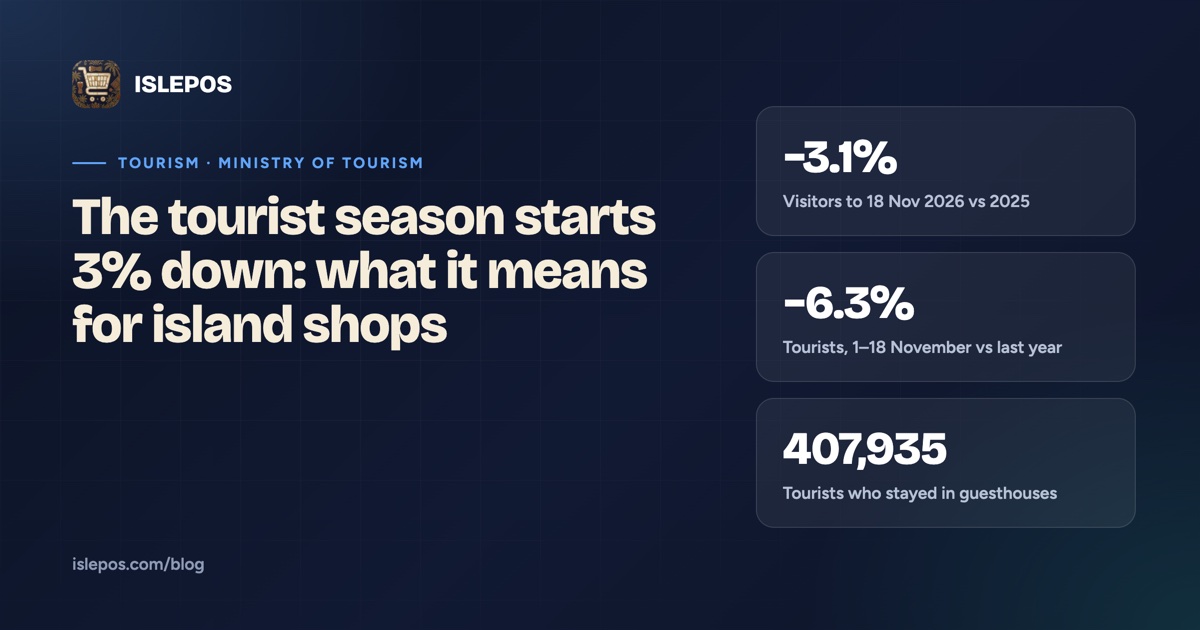
The Tourism Ministry's update of 19 November puts arrivals 3.1% behind last year, and November 6.3% behind so far. Who is coming, where they stay, the new winter flights, and how a shop on a guesthouse island should stock and price for the busy months.
December to April is when a shop on a guesthouse island earns its year. Snacks, water, sunscreen, snorkel gear, souvenirs, coffee — tourists buy them every day, and the shops that run out in February lose sales they cannot get back. So the numbers going into this season matter. The Ministry of Tourism and Civil Aviation's latest weekly update, dated 19 November, has them (Maldives Tourism Updates, 19 November 2026).
These are official counts, not forecasts. This post sets out what they say, who is coming and where they stay, and what a shop should do before the busy months start.
1. Arrivals are behind last year
By 18 November, 1,906,152 visitors had come to the Maldives in 2026, against 1,967,800 by the same day in 2025: 3.1% fewer. Counting tourists alone (without business visitors and cruise passengers), it is 1,871,843 against 1,943,305. On an average day this year, 5,813 tourists arrived, against 6,035 last year (Ministry of Tourism, 19 November).
The year has not been even. February was 17.7% up on last year; then March fell 19.8%, April 24.4% and June 12.0%. Since July the gap has almost closed: August was up 2.1%, September down 0.2%, and October up 0.9%. November so far is not as good. In the first 18 days, 109,092 tourists arrived, against 116,371 in the same days last year — 6.3% fewer.
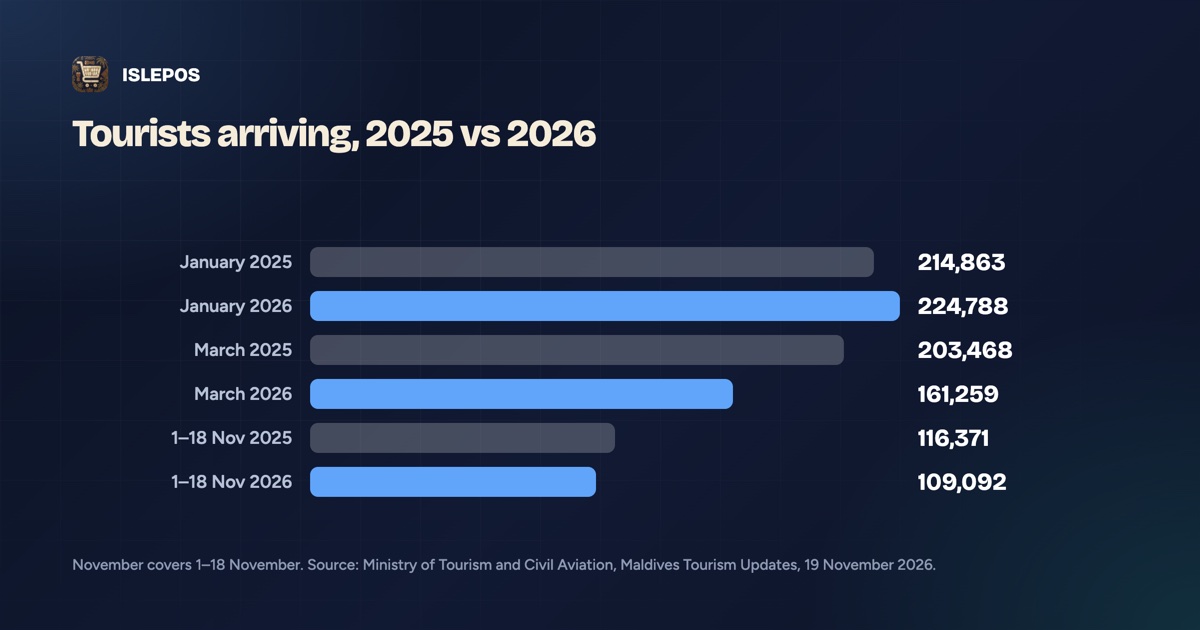
Look at last year's months to see what the season means. In January 2025, 214,863 tourists arrived; in February, 214,091; in March, 203,468. In June 2025 it was 141,772. That is roughly half as many people again in a peak month as in a quiet one — and on a small island, many of them walk into the same few shops.
The wider economy shows the same thing. The Maldives Bureau of Statistics' monthly growth indicator, published on 15 November, found accommodation and food services 0.4% smaller in September than a year earlier, "primarily attributable to a decline in the number of tourist bed-nights". It is still the biggest part of the economy, at 18.5%. Wholesale and retail trade, meanwhile, grew 8.8% (MIEG September 2026, Maldives Bureau of Statistics).
2. Who stays on local islands
Most tourists never see a local island shop: 73.9% of this year's tourists stayed in resorts. But 407,935 — 21.8% — stayed in guesthouses. There are 930 guesthouses with 16,980 beds, on 111 islands in 20 atolls. Almost half of those beds, 7,894, are in Kaafu (Malé) atoll, followed by Alifu Alifu (2,276), Alifu Dhaalu (2,048) and Baa (1,536) (Ministry of Tourism, 19 November).
Where visitors come from changes who walks in. China is the biggest market this year, with 343,071 tourists (18.3%), then Russia (272,756), the UK (146,025), Germany (130,128), Italy (111,951) and India (110,141). And some nationalities choose guesthouses far more than others:
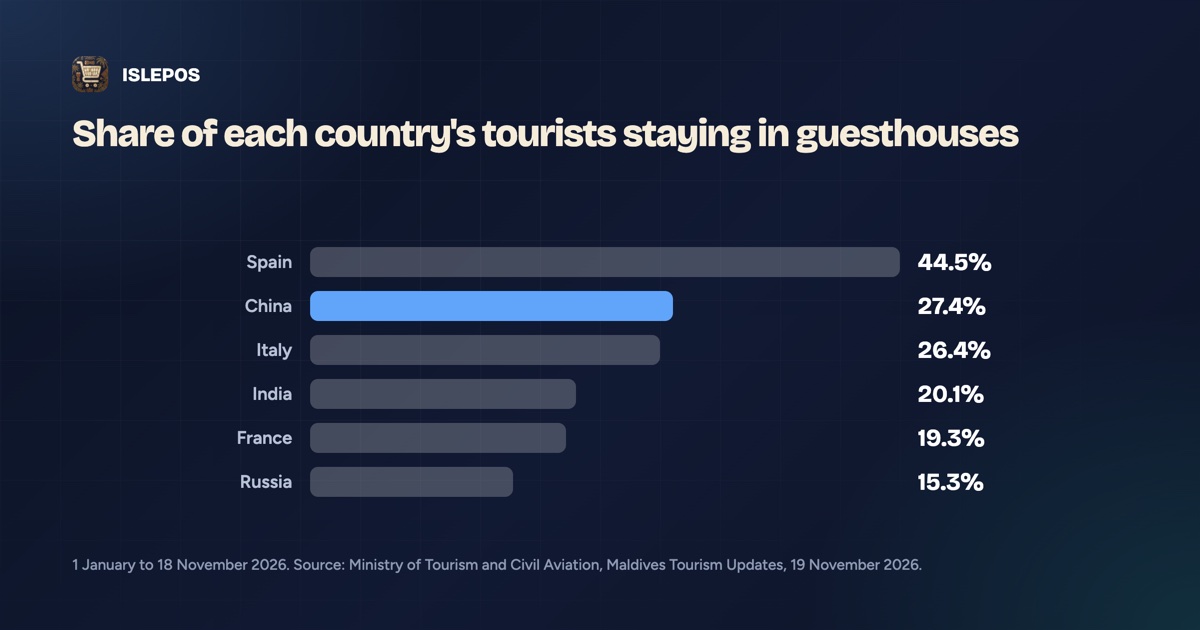
Put the two together and, by our arithmetic, Chinese visitors are the largest group in guesthouses by a distance: 27.4% of 343,071 is about 94,000 people, against roughly 42,000 Russians and 30,000 Italians. Only 8.4% of British visitors and 13.0% of Germans stayed in guesthouses.
3. New flights for the winter
On 21 November Corporate Maldives reported, citing the Tourism Ministry, that five airlines will start flying to the Maldives this winter: VietJet, Kuwait Airways, French Bee, Siberian Airlines and ShirakAvia, linking the country with Vietnam, Kuwait, France, Russia and Armenia (Corporate Maldives). These are announced routes; the report does not give start dates or how many flights a week. Separately, the national airline Maldivian now flies its own Airbus A330 direct to Beijing, Chengdu, Shanghai and Melbourne, and Australia has entered the top ten source markets for the first time (Corporate Maldives) — it is seventh this year, with 44,064 tourists.
For scale: in October the busiest foreign airlines were Emirates (26 flights a week), IndiGo (23), SriLankan (19), and Etihad and flydubai (17 each), by the ministry's weekly averages. New routes add seats, but whether they make up for this year's gap is something only the December and January numbers will show.
4. What it means for a shop
- Plan for a busy season, but not a record one. Arrivals are close to last year since July, but November is running 6.3% behind. Stock up on what you know sells, and be careful with new lines you would struggle to sell in June.
- Know who is on your island. Ask the guesthouses nearby where this season's bookings come from. What sells to a guesthouse full of Chinese families is not the same as what sells to a group of European divers.
- Run-outs cost more than leftovers for the season's best sellers. Water, sunscreen, snacks and soft drinks keep. A supply boat that is late in February costs you a week of sales.
- Make paying easy. Tourists carry cards and dollars. Show your prices clearly and know the rules for taking foreign currency — we covered them in Dollars and your shop.
What to do before December
- Pull last season's sales, December to April, by week. Find your 20 best sellers and the weeks you ran out of any of them.
- Order earlier than you think. Allow for the boat, the weather, and suppliers in Malé running short when every island orders at once.
- Set a reorder level for each best seller, so you see it running low before the shelf is empty.
- Check your prices against your newest costs — food prices in Malé are up about 10% in a year, as we wrote in our post on the October price index.
- Watch the ministry's tourism update, published most weeks. If December is still behind last year, go easier on the January order.
In ISLEPOS, low-stock alerts warn you before a best seller runs out, a purchase order turns the list into an order for your supplier, exporting a report gives you last season's sales by item, and you can take payment in another currency at the till.
Sources
- Maldives Tourism Updates — 19 November 2026 (PDF, figures as of 18 November) — Ministry of Tourism and Civil Aviation, 19 November 2026
- Statistics publications and weekly updates — Ministry of Tourism and Civil Aviation, 19 November 2026
- Monthly Indicators of Economic Growth, September 2026 (PDF) — Maldives Bureau of Statistics, 15 November 2026
- Five International Airlines Launch Winter Flights to the Maldives — Corporate Maldives, 21 November 2026
- Maldivian Launches Direct Wide-Body Flights to China and Australia — Corporate Maldives, 21 November 2026